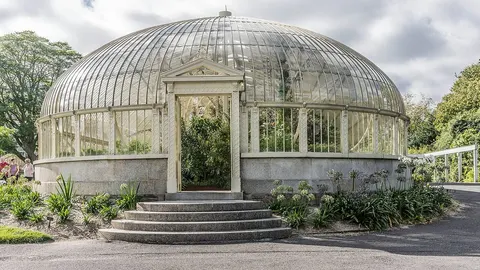

Dublin's National Botanic Gardens are worth visiting for their historic glasshouses, living plant collections and unhurried atmosphere, especially when you want a break from ticketed city attractions. General admission is free. The trade-off is location: Glasnevin is outside the central sightseeing circuit, so give it a dedicated half-day rather than squeezing it between appointments. [1]
What makes this different from another park?
Go for the combination of plants and architecture. The Curvilinear Range and Great Palm House are restored historic glasshouses associated with ironmaster Richard Turner. Their structures are part of the attraction, not simply weatherproof containers for the collection. The gardens also have a conservation role, including plants endangered in their natural habitats. [1]
That gives you two ways to enjoy the visit. Someone interested in design can look at how the ironwork, glazing and curves create growing spaces. A plant enthusiast can spend longer comparing labels and environments. Neither needs to turn the afternoon into an examination: choose a few specimens or details that interest you rather than trying to read everything.
Outside, the official tourism guide highlights the rose garden, herbaceous borders, rock garden, alpine yard, pond area and arboretum. These provide different reasons to visit at different times of year. Do not expect the summer flower display to be the standard against which every winter visit should be judged. [2]
The gardens' virtual tours offer a useful preview of the Palm House, Curvilinear Range and other collections. Use them to decide which features deserve your attention, not as evidence that every space shown is open on your particular day. A virtual viewpoint can include perspectives unavailable on an ordinary visit. [3]
Who should make the journey?
Put the gardens high on your list if you enjoy horticulture, botanical illustration, glasshouse architecture or slow outdoor photography. They also make a sensible choice when the cost of several central attractions is pushing the trip beyond your budget. Free entry means you can leave when you have had enough without feeling obliged to recover an admission charge.
For a first visit lasting only one day, the decision is less obvious. A central historical walk might answer more of your questions about Dublin. Choose Glasnevin instead when the garden itself is an interest, not because a list tells you every visitor must see it.
With children, plan a search rather than an endurance test: find a leaf with an unusual shape, compare two tree trunks, then take a break. Keep the activity observational. This is a botanical collection, not a place to pick specimens or climb structures; the operator prohibits climbing and allows assistance dogs rather than ordinary pet dogs. [1]
The sheltered collections make mixed weather less of a deterrent, but this is not a completely indoor attraction. You still need to move between buildings and outdoor areas. Choose a museum instead when your priority is an uninterrupted, fully sheltered afternoon.
Free admission and paid tours are different things
You can explore independently without paying garden admission. The current OPW listing separately advertises guided tours at €5, with departures at 11:30 and 15:00. Groups buying five or more tickets are directed to contact the gardens. Themed events have their own booking arrangements. [1]
This distinction matters because older visitor descriptions can make a garden tour sound automatically included. Build your plan around the current operator's terms, not a remembered offer. A free walk and a booked interpretation session are different products even when they take place in the same grounds.
For an independent visit, allow roughly two hours as a planning choice: one focused glasshouse visit, an outdoor circuit and time to pause. That is not a measured average or a requirement. Add time for a tour, detailed plant study or a meal, and shorten the route rather than hurrying through everything.
A guided visit is particularly useful when you want to understand how the collection works rather than simply see attractive plants. Reserve enough time afterwards to revisit the section that caught your attention; otherwise the guide's route can become your entire experience.
Build the visit around daylight and the right entrance
As checked on 6 November 2026, the gardens' own visitor information shows winter opening until 16:30, starting at 09:00 on weekdays and 10:00 at weekends and public holidays. Confirm the displayed seasonal schedule when choosing a date outside winter. The institution has two locations: Glasnevin in Dublin and Kilmacurragh in County Wicklow. They are not neighbouring entrances to one garden. [4]
A late-afternoon arrival is therefore a poor choice in winter. Put the outdoor section first while daylight is useful, then fit the sheltered collections around their actual availability. Do not assume that an open gate means every building, café or exhibition remains accessible until the final minute.
Enter National Botanic Gardens, Glasnevin as the destination in your journey planner. Plan both directions from your accommodation rather than copying a bus number from an old article. A route that looks convenient from O'Connell Street may not be the simplest from a hotel elsewhere.
Walking from the centre is possible as part of a deliberately longer urban outing, but it uses energy before the garden visit begins. For travelers with limited walking stamina, spend that energy inside the collection and take transport for the approach.
The gardens provide a visitor contact for accessibility questions. Ask about the specific glasshouse, path surface or entrance you need, rather than relying on a general accessible label. Mention the dimensions of a mobility aid and whether steps, gradients or a long walk would prevent the visit. [4]
Pair it with Glasnevin without overloading the day
A pedestrian gateway links the gardens and Glasnevin Cemetery, according to Dublin Cemeteries Trust. That creates a coherent combination: plants and architecture first, followed by a separately planned historical visit. Cemetery tours and visitor experiences are not included merely because the adjoining gardens are free. [5]
Choose the order around a booked tour. For example, a morning garden visit can lead into an afternoon cemetery appointment, with a proper break between them. Avoid booking two tightly spaced tours and assuming the connecting gate eliminates all walking or orientation time.
The cemetery operator says its visitor centre and guided-tour route are wheelchair accessible apart from Daniel O'Connell's crypt, which involves steps. Treat that as information about the cemetery experience, not a blanket statement about every part of the neighbouring gardens. [5]
The strongest reason to visit Glasnevin's gardens is that they reward attention without demanding an expensive or heavily scheduled day. Choose them for a real interest in their collections, arrive early enough to explore calmly, and leave room for whatever proves more engaging than expected. That is a better use of the place than adding a hurried photograph to an already crowded itinerary.
Source & editor notes
Selection is based on the collection, architecture, cost and practical fit, not a firsthand visit. OPW's paid-tour listing takes precedence over older free-tour descriptions. Garden access and a cemetery experience are separate arrangements.