For botanical gardens in Dublin, make Glasnevin your first choice: its outdoor collections and historic glasshouses are free, and you can enjoy a worthwhile visit without booking a tour. Choose a guided visit for interpretation, not admission. The separate National Botanic Gardens site at Kilmacurragh is in County Wicklow, so it belongs in a different day's itinerary. [1][2]
The useful question is not whether to see the gardens or the greenhouses. At Glasnevin they complement one another. A good visit alternates between the architecture, living collections and outdoor landscape, rather than treating the glasshouses as a shelter to dash into when it rains.
Start with the glasshouses, but choose what interests you
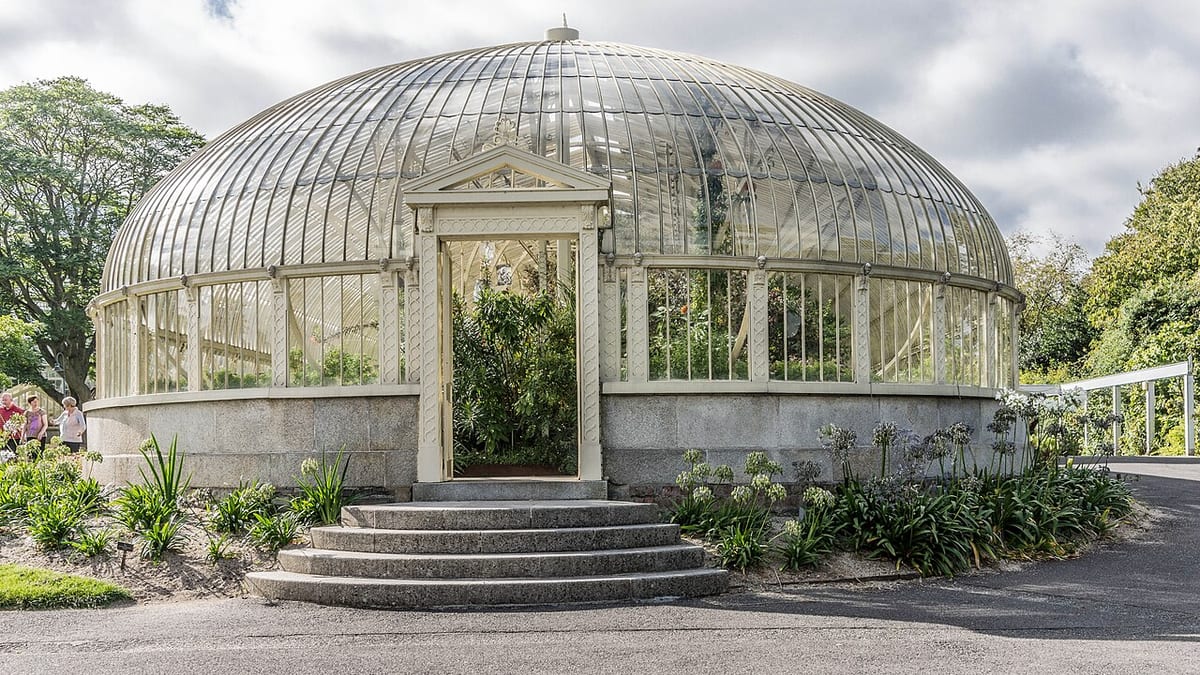
The two headline structures are the Curvilinear Range, associated with ironmaster Richard Turner, and the Great Palm House. Both are recognised for their restoration. They are part of the free visitor experience rather than separately ticketed attractions. [1][3]
For an architecture-led visit, begin by looking at the buildings from outside. Notice how the framework supports the glazing and how differently the long, curved range and the taller palm house occupy the garden. Going straight inside misses the relationship between the structures and their setting.
Inside, use the plant labels to slow your visit down. Comparing two related plants from different habitats is more revealing than trying to photograph every specimen. You do not need botanical expertise: leaf shape, growth habit and the way a plant uses its available space provide straightforward starting points.
The Alpine House and adjoining yard offer another kind of collection, with changing displays of alpine plants. Do not expect every glasshouse to reproduce a hot, tropical climate. Different growing environments are precisely what makes a botanical collection interesting. [3]
A sensible first-visit route is to choose two principal houses and one smaller collection, then spend the remaining time outside. That creates variety without turning the afternoon into a race between labels. Enthusiasts can reverse the balance and give most of their time to a particular plant group.
Free entry and guided tours are different decisions
Ordinary admission does not require you to purchase a tour. The gardens' dedicated tours page, updated in June 2026, says that daily guided tours require booking. Heritage Ireland separately lists a €5 guided tour, with daily departures at 11:30 and 15:00; the actual booking calendar is the appropriate place to choose an available session. [1][4]
A guide is most useful when you want an explanation of the collections' purpose, plant relationships or the institution's history. Independent visiting is better when your group needs frequent rests, you are photographing plants, or you would rather change direction according to the weather.
For two adults, the listed tour charge would add €10 to an otherwise free visit. That is a small, clear purchase rather than a prerequisite for seeing the highlights. There is little reason to buy a wider sightseeing pass solely to obtain access to gardens that are already free.
Older text on the glasshouse page describes a different weekly tour arrangement. Rather than assuming that an old Sunday offer still applies, follow the newer tours page and its reservation process. This is a booking distinction, not evidence that the glasshouses themselves have become chargeable. [3][4]
Shape the visit around daylight, not just opening hours
The operator publishes different summer and winter patterns. Its winter schedule is 09:00–16:30 on weekdays and 10:00–16:30 at weekends and public holidays. Entrance gates close 15 minutes before the stated closing time, and Christmas Day is excluded from normal year-round opening. [5]
The same page retains a summer-hours notice without clearly stating the autumn changeover date. For a late-October or early-November visit, a morning arrival avoids depending on that ambiguity. It also leaves you more freedom to extend the outdoor portion when the weather is pleasant.
Allow roughly two hours for a selective independent visit, or longer when adding a guided tour and a café stop. This is a planning recommendation, not an official minimum. A serious photographer or gardener could reasonably spend much more time, while someone seeking a short restorative walk may be satisfied sooner.
In colder months, put the exposed outdoor section in the brightest part of your visit. In summer, avoid designing the entire route around flowers: a living collection also rewards attention to trees, foliage and the structures supporting plant growth. Seasonal variation changes what you notice; it does not turn the garden into an all-or-nothing attraction.
Bring a layer you can comfortably carry indoors. A glasshouse visit still involves moving between separate buildings and outdoor paths, so it is not equivalent to spending an afternoon inside a single museum.
Accessibility and the practical details that matter
The gardens describe their paths as generally broad and surfaced, while noting steps in two locations. The glasshouses are accessible, but some have particular approaches: the Alpine House uses its rear doors, and the west wing of the Curvilinear House is reached through the central section. [6]
This makes the access map more useful than a simple wheelchair symbol. Plan a connected route between the houses you want to see rather than assuming every visible entrance works equally well. The Visitor Centre has reception, toilets and café facilities, making it a logical first stop for orientation. [6]
Loan wheelchairs are available there on a first-come basis and cannot be reserved. A visitor who depends on having a chair should therefore bring their own or arrange independent equipment rather than building the day around an uncertain loan. [6]
Think of the gardens as a working collection, not a substitute for a recreation ground. Choose a café break instead of assuming that every lawn is available for games or a picnic. For children, a simple observation task - finding contrasting leaves or comparing the shapes of the glasshouses - can make the visit engaging without treating the plants as play equipment.
Add Glasnevin, or keep the afternoon focused
An adjoining pedestrian connection makes Glasnevin Cemetery a logical extension. Its museum and organised tours are separate experiences, with their own arrangements; free entry to the gardens does not include them. [7]
The combination works best when you have a genuine interest in both subjects. After several hours among plants, adding a detailed historical tour may be rewarding, but it is not automatically better than leaving time for a meal and an unhurried return. A cemetery also calls for a different atmosphere from a family garden outing.
Kilmacurragh is another option entirely. Located in County Wicklow, it offers free garden admission and a different landscape, rather than a second city-centre glasshouse complex. Treat it as a countryside excursion with its own transport plan, not an extra stop between Glasnevin and dinner in central Dublin. [2]
For most first-time visitors, Glasnevin alone provides the strongest balance: distinctive glasshouses, outdoor collections, optional interpretation and no entry charge. Spend the money you save on the part that improves your own visit - a guide, a relaxed lunch or transport - rather than on an unnecessary package.