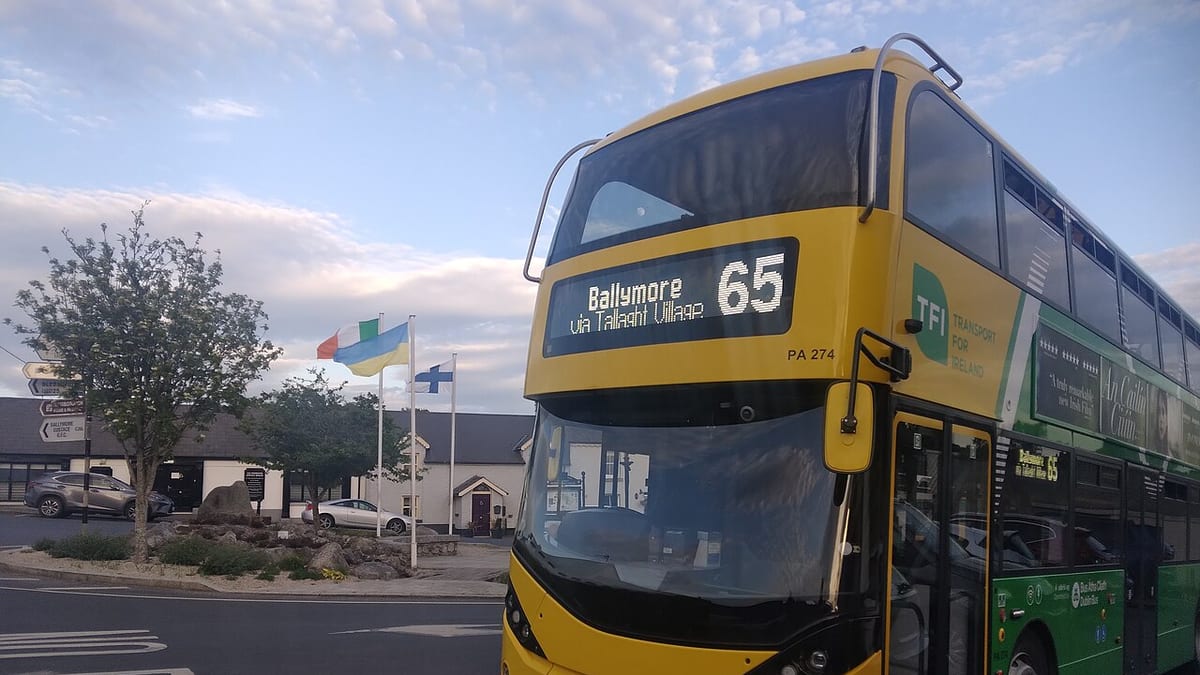
You cannot currently tap a bank card or phone wallet to pay on an ordinary Dublin Bus service. A Leap card is contactless, but it is a separate transport card, not your debit card. Some airport coaches and Local Link services accept bank-card payments, so the answer depends on the operator rather than the city. [1][5][6]
Why the contactless symbol can be misleading
The important distinction is between contactless technology and an open payment system. Dublin Bus has readers that recognise Leap cards. That does not mean the same reader accepts a Visa card, Mastercard, Apple Pay or Google Pay. Its airport information explicitly says that bank-card and phone tap-to-pay are not accepted on its regular services. [1]
For a visitor, the practical consequence is simple: decide how to pay before joining the boarding queue. Do not board expecting the driver to process your bank card because it worked in a shop, on another country's buses or on an airport coach earlier that day.
Also separate buying a ticket from validating a journey. Paying for Leap credit with a bank card is a purchase of transport credit. It does not turn that bank card into the ticket you subsequently present on the bus. Keep the physical Leap card available throughout the journey. [4]
This guide describes arrangements checked on 30 October 2026. A future payment-system announcement is not evidence that bank-card acceptance has already reached the bus standing in front of you.
Paying with Leap: what to do at the door
For most visitors taking several ordinary public-transport journeys, a physical Leap card is the straightforward reusable option. The adult TFI 90 Minute Fare is €2 for eligible journeys in Dublin's Zone 1, including Dublin Bus, eligible Go-Ahead city services, Luas and DART or commuter rail. The integrated fare does not make every bus or every rail journey in the wider region eligible. [3]
On a bus, you touch on; you do not touch off when leaving. On Luas and rail, the normal procedure is to touch on and touch off. This difference matters when combining modes: copying your bus habit at a railway station can leave the rail journey incorrectly recorded. [4]
Dublin Bus's boarding guidance distinguishes between paying through the driver and using the validator for the applicable prepaid fare. Follow the instructions beside the reader, and ask the driver when you need a different fare or are unsure which procedure applies. Keep the card against the reader until it gives a successful response rather than waving it past quickly. [2]
Remove the transport card from a wallet containing several contactless cards. That makes the intended payment method unambiguous and avoids repeated unsuccessful attempts. Once validated, move away from the entrance so the next passenger can board.
The Leap Top-Up app is useful for adding credit to a compatible physical card. It is not a replacement bus ticket displayed on your phone. Loading credit and completing a valid boarding are separate steps. [4]
What a day's travel could cost
The adult daily cap for eligible Zone 1 Leap travel is €6, with a €24 Monday-to-Sunday weekly cap. These are public-transport caps, not a promise that any service displaying a Dublin destination is included. Private airport coaches, for example, sell their own tickets. [3][6]
Consider three separate outings, each outside the preceding 90-minute fare window: a morning museum trip, an afternoon visit and an evening return to your accommodation. At €2 each, the eligible adult fares total €6. An additional eligible journey that day would then be covered by the daily cap. This is a calculated example, not a claim about every possible itinerary.
By contrast, several eligible transfers completed within the relevant 90-minute conditions may cost less than treating each leg as a separate outing. Do not deliberately space journeys out to reach a cap: it is a ceiling, not a target.
For a family, calculate each traveller's appropriate fare separately. Avoid assuming one physical card can serve as several people's individually capped travel account. Have each person's ticket or card arrangement settled before boarding; discounted eligibility and children's fares should be checked against the official fare information. [3][4]
Arriving at the airport without a Leap card
At Dublin Airport, identify the company on the vehicle and ticket page. A Dublin Bus airport service and a private airport coach are not interchangeable payment systems. The airport hub page gives a standard adult cash fare of €2.60 for Dublin Bus and explicitly warns that bank cards and phone wallets cannot be tapped aboard. [1]
That makes cash a useful fallback when taking an ordinary city bus without Leap. Have suitable coins ready and confirm the appropriate fare with the driver; do not rely on a large banknote as your only boarding plan. The operator's current fare and boarding instructions take precedence over an old travel-blog quotation. [1][2]
Aircoach, in contrast, advertises bank-card, Apple Pay and Google Pay payment for its Dublin services. Its tickets are separate from Leap's integrated city fares. The extra convenience may matter after a late arrival, but compare the coach's actual destination with your hotel rather than choosing solely because the payment method is familiar. [6]
For a prebooked coach, save the issued ticket rather than assuming the card used at checkout is all you need. A booking confirmation, a QR ticket and an onboard card payment are different ways of demonstrating entitlement to travel.
Why Local Link announcements do not change Dublin Bus
TFI has been introducing contactless bank-card payments on Local Link services, with rollout information published by area. The Local Link payment page describes an expansion across regular services; it does not announce universal bank-card acceptance on every Dublin city bus. [5]
This is the source of much understandable confusion. Both networks may appear under the wider Transport for Ireland umbrella, yet their payment equipment and implementation dates differ. A headline about one county's Local Link buses should not be applied to a Dublin Bus route without checking that operator.
Use the route's actual operator as your first filter. Then establish whether you are purchasing a separate ticket, using a transport smart card or tapping a bank card directly. Those three questions are more useful than asking whether Ireland is generally "contactless".
A reliable setup for a short visit
For repeated city travel, arrange the relevant Leap card or ticket before the first busy boarding and retain a small cash fallback. For a single airport-coach journey, buy the appropriate operator ticket and keep it accessible offline. For a mixed itinerary, maintain both arrangements instead of expecting one payment method to cover everything.
Before leaving accommodation, check that the physical card is in your pocket and that any required top-up has actually reached it. A successful bank transaction is not always the same thing as travel credit being available on the card. [4]
The decisive rule remains clear: ordinary Dublin Bus travel currently requires its accepted transport ticket or cash arrangement, not a bank-card tap. Choose the payment method for the service you will actually use, and the system becomes much less confusing. [1]