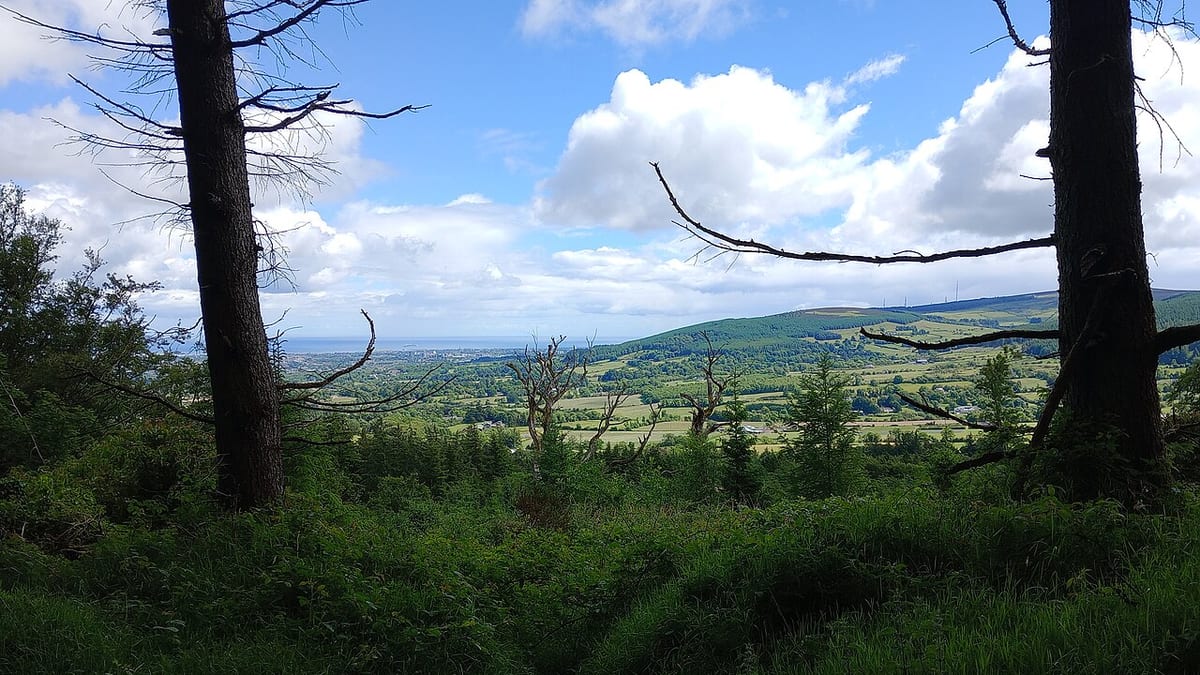
The simplest public-transport trip from Dublin to the Wicklow Mountains is usually the direct St Kevin's bus to Glendalough. Driving gives greater flexibility for dispersed trailheads, while a guided trip suits visitors who want several stops without arranging connections. Choose your walking destination first: getting to Glendalough is not the same as reaching every part of the national park. [1][2]
The direct bus: straightforward, but timetable-led
St Kevin's operates the Dublin–Glendalough service throughout the year except Christmas Day. Its Dublin terminus is on St Stephen's Green North, opposite Stephen Court, and the Glendalough stop is at the Visitor Centre. Tickets are purchased on the bus. [1]
The published adult fare is €23 return or €14 single from Dublin. A return is valid for 30 days and is not transferable. The operator accepts most credit and debit cards, cash and Leap, but explicitly excludes Leap Visitor and Young Adult products from the stated payment arrangement. [3][4]
This is a useful direct option when the valley itself is your destination. You avoid organizing a train-to-bus interchange, but you also accept the operator's departure times. Do not treat it as a frequent urban service where missing one bus merely costs a few minutes.
The winter timetable, labelled 1 November–28 February, shows an 11:00 Dublin departure arriving in Glendalough at 12:20. The afternoon return leaves Glendalough at 16:30 and reaches Dublin at 18:00. Those times apply to the winter pattern, not automatically to every date of the year. [5]
What the winter timetable really gives you
The interval between a scheduled 12:20 arrival and 16:30 departure is four hours and ten minutes. That is the entire time in Glendalough, not four hours and ten minutes of hiking.
As an illustrative plan, allow 15 minutes after arrival to orient yourself and use facilities, 40 minutes in total for the approach to and return from the Upper Lake area, and a 20-minute margin at the return stop. That leaves about two hours and 55 minutes for the chosen walk, sightseeing, food and pauses. These are editorial allowances, not measured queue times or an operator guarantee.
The park describes the Visitor Centre car park as approximately a 20-minute walk from the Upper Lake. [6] That approach is why a route starting beside the Upper Lake can take longer than its headline trail time suggests when you arrive by bus.
For a winter bus day, a modest lake walk with time in the monastic area is a more comfortable plan than a strenuous circuit that uses almost the whole window. A late inbound arrival reduces your available time further. Shorten the route rather than borrowing from the return margin.
Photograph the return stop or note it on an offline map before setting off. The point is not to create unnecessary anxiety; it is to avoid spending the final minutes looking for a bus stop you passed several hours earlier.
Local Link: useful connections, but old route advice can mislead
The Local Link network changed in December 2025. The operator's service notice says route 183 now runs between Arklow and Glendalough, while route 895 connects Glendalough with Sallins via Blessington. The notice describes four return journeys daily on route 895 and coordinated connections between the two routes at Glendalough. [7]
This matters because older advice may still describe route 183 as a through service between Sallins and Arklow. Use the present route numbers and dated journey results instead of relying on that older description.
For a Dublin departure, a rail connection towards Sallins followed by route 895 may offer a useful alternative, depending on the date and your starting point. However, assess the complete journey in a current planner. A bus route existing at the destination does not prove that the train and bus connect conveniently for your intended walk.
Compare the return first. An outward connection can look attractive while the evening combination leaves a long wait or an awkward final leg. Also distinguish an advertised coordinated connection between two buses from an assumed connection between a train and a bus.
These alternatives are particularly relevant when staying outside central Dublin or continuing elsewhere after Glendalough. For a straightforward first-time day trip from the centre, the direct bus may remain easier even when another routing looks marginally cheaper.
Driving: flexibility comes with a parking decision
A car is useful when your destination is not the main Glendalough valley or when you need an earlier trail start than the direct bus allows. It also lets you organize a route around the group's pace rather than a fixed afternoon departure.
Do not turn that flexibility into a string of rushed stops. Select the principal walk, then decide whether any scenic detour still fits comfortably. Driving time should be estimated for the actual route and date, not from a best-case journey between two town names.
Glendalough has several parking choices. The park identifies paid parking near the Visitor Centre and Upper Lake, plus free parking at Laragh, approximately 3 kilometres from the Upper Lake Information Office. [6]
The free option can therefore add roughly 6 kilometres for the approach and return. That may suit enthusiastic walkers, but it is a substantial change to a short family outing. The closest parking to the intended trail can be better value even when it carries a fee.
The park also warns against roadside parking that obstructs access. [6] A full car park is a reason to change the plan, not to block a narrow approach road. Have a shorter or different outing in mind before reaching the valley on a busy day.
For a hired car, compare the total cost for the group, including rental conditions, fuel and parking. Do not justify a car solely by dividing the daily hire price between passengers while ignoring the other costs and the responsibility of driving.
Guided trips: examine the itinerary rather than the headline
A guided day trip can be appropriate when transport and several short visits are the attraction. It is not automatically a replacement for an independent hiking day. Before paying, inspect the actual time allocated to Glendalough, the walking expectations and whether the itinerary is primarily scenic sightseeing.
A tour that includes several destinations must divide the day among them. Someone who wants an unhurried mountain walk may be happier with one destination and a longer stay. Someone who wants an overview without navigating rural connections may prefer the guided format.
Also check the meeting point and the return location. A tour marketed from Dublin may not collect from every hotel, and an early departure requires a realistic journey to the meeting point. Keep any evening restaurant reservation flexible enough to absorb traffic.
No single tour price is quoted here because inclusions, dates and availability vary. Compare a specific bookable departure with the independent trip you would actually take, not with an imaginary version containing more walking time and fewer restrictions.
Choose the route that supports your day
For a first visit focused on Glendalough, start with the direct bus and build the walk around its timetable. For a dispersed landscape itinerary or an early, demanding hike, a car or appropriately designed guided service may be a better tool. For travel linked to Wicklow or Kildare towns, investigate the updated Local Link network. [1][7]
Whatever you choose, keep the return journey, the trailhead approach and the walk itself as three separate parts of the plan. That is the difference between merely reaching the mountains and having enough time to enjoy them.