
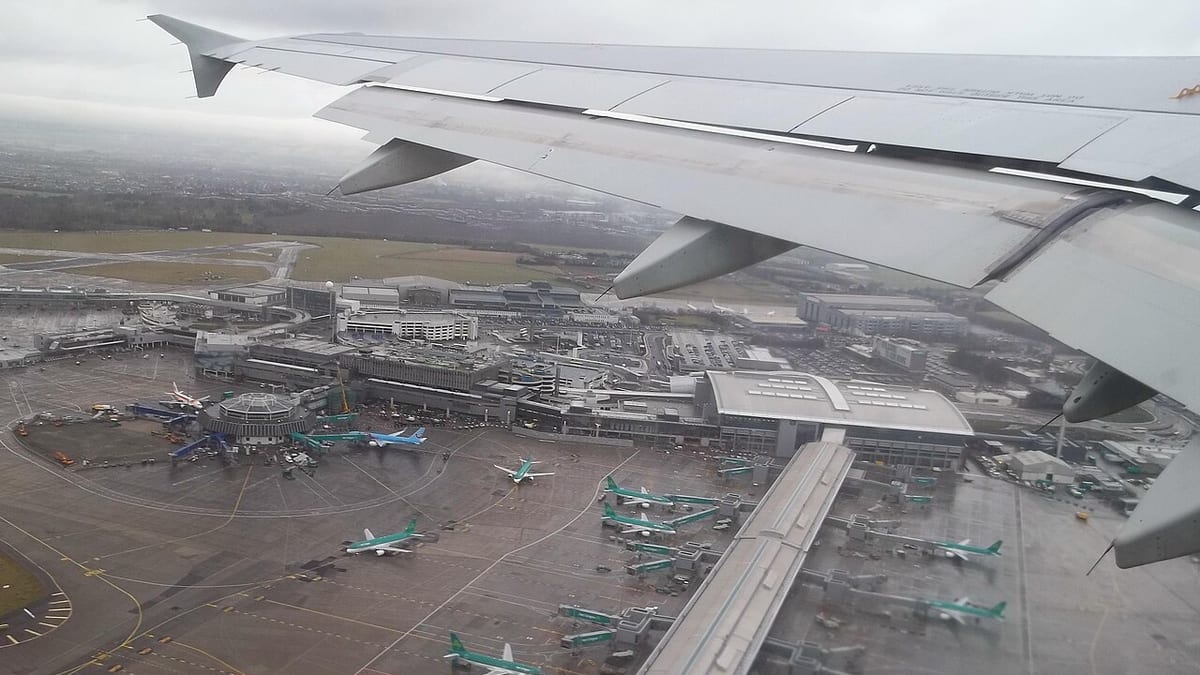
Dublin Airport recommends reaching your terminal two hours before a short-haul flight and three hours before a long-haul flight, with extra time for checked luggage or groups. Treat those as starting points, not boarding deadlines. Your airline's instructions, bag-drop opening and any U.S. preclearance requirement can change the practical plan. [1]
Count arrival at the terminal, not departure from the hotel
For a 10:00 short-haul flight, the airport's baseline means being at the correct terminal around 08:00. It does not mean leaving central Dublin at 08:00 or entering a remote car park then.
Work backwards through the whole journey. Include getting downstairs, walking to a bus stop, waiting for transport and moving from the arrival point to the check-in area. A quoted vehicle journey is only one part of that chain.
As an illustrative plan, suppose you want to reach the terminal at 08:00 and choose to allow 45 minutes for the journey plus a 20-minute disruption buffer. You would leave at 06:55, before adding any separate walk or wait not included in those assumptions. These numbers are a planning example, not a prediction of Dublin traffic.
For airport parking or a rental-car return, add the transfer from that facility separately. "At the airport" can describe a wide area; the useful target is the terminal entrance with your luggage and documents.
Check the terminal against the airline and flight, rather than following a travel companion's memory. Dublin Airport publishes airline-specific terminal and check-in information. [2]
Checked bags add a separate queue and deadline
Online check-in does not eliminate bag drop. The airport advises checking the airline's desk opening times and, where possible, allowing up to one additional hour for checked luggage. That does not mean every passenger will spend an hour in a bag queue; it is a buffer recommendation. [3]
Arriving very early only helps if the desk can accept the bag. If it is not open, you may wait landside with luggage rather than gain extra time beyond security. Use the airline's current opening and closing rules to find the useful arrival window.
Treat the closing time as a hard constraint, not a sensible arrival target. A traveler reaching the end of a queue just before bag-drop closure has not necessarily completed the required process.
For families, separate the tasks in advance. Decide who holds the passports, who manages the bags and whether a pushchair or other item needs special handling. A clear division of tasks reduces avoidable confusion without assuming the queue will be short.
Keep essential medication and documents accessible. Do not pack something needed at a desk into a suitcase that must then be opened on the terminal floor.
U.S. preclearance adds another stage
Dublin Airport says most direct U.S. departures from Terminal 2 use preclearance, but passengers should confirm whether it applies to their flight. It means U.S. immigration, customs and agriculture checks take place before departure rather than being left entirely until arrival in America. [4]
The airport's published baseline for these long-haul journeys remains three hours at the terminal, with more time for bags or groups. It identifies 05:00–12:00 as a busy Terminal 2 period, so do not infer that an early morning flight automatically means an empty terminal. [4]
The sequence matters: airline check-in where required, airport security, then U.S. preclearance when the departure screens direct you to proceed. Do not spend the available margin shopping and assume the final checkpoint is a formality. [5]
Follow the instructions for your flight rather than a generic story about someone else's quick experience. Immigration questions, document checks and family circumstances are individual. A short queue on another day does not establish how long your own process will take.
Confirm travel documentation before the airport day. Extra arrival time can help with ordinary queues; it cannot be relied on to solve missing authorization or an unsuitable passport at the last minute.
The queue display is an indicator, not a reservation
Dublin Airport explains that its displayed security time represents the median time experienced during the previous 15 minutes, rather than a fully real-time promise. Individual waits can be longer or shorter. [3]
That is a useful operational distinction. Seeing a short displayed wait while eating breakfast in the city does not reserve that queue length for your arrival.
The measurement also has boundaries. The airport says the Terminal 1 figure covers the queue on the departures floor, while Terminal 2 is measured from the top of the Level 2 escalators; queues extending beyond those points are not fully represented. [3]
Use the display to understand conditions after you have already allowed a sensible margin. Do not subtract most of the airport's recommended arrival buffer because one number looks reassuring.
The same logic applies to paid priority products. A faster security lane does not remove check-in, passport requirements, walking to the gate or the airline's boarding deadline. Buy it for convenience where useful, not as permission to arrive recklessly late.
Early flights and packing rules
Security currently opens at 02:30 in Terminal 1 and 03:30 in Terminal 2. An unusually early arrival before those times may simply mean waiting outside the screening area. Coordinate the security opening with the airline desk hours when planning an overnight or dawn departure. [6]
Dublin's current screening rules allow liquids in containers up to two litres, with liquids and electronics left in cabin baggage. This is airport-specific guidance: another airport on the same itinerary may have different rules. Do not repack for a return flight elsewhere on the assumption that Dublin's arrangement applies universally. [6]
Preparing correctly is still worthwhile. Know where your boarding pass is, keep pockets easy to empty and avoid burying a document beneath several layers of clothing. Small organizational choices matter most when you are tired or traveling with others.
For a straightforward cabin-bag-only short-haul trip, begin with the two-hour terminal target. For long-haul, begin with three. Then add the time your actual circumstances require, using the airline's current instructions where they are more demanding. That produces a defensible plan without pretending there is one arrival time that guarantees every journey.
Source & editor notes
Airport recommendations are distinguished from airline deadlines and hypothetical journey calculations. Queue-display methodology is explicitly attributed. U.S. preclearance and cabin-baggage rules must be checked against the specific flight and other airports on the itinerary.