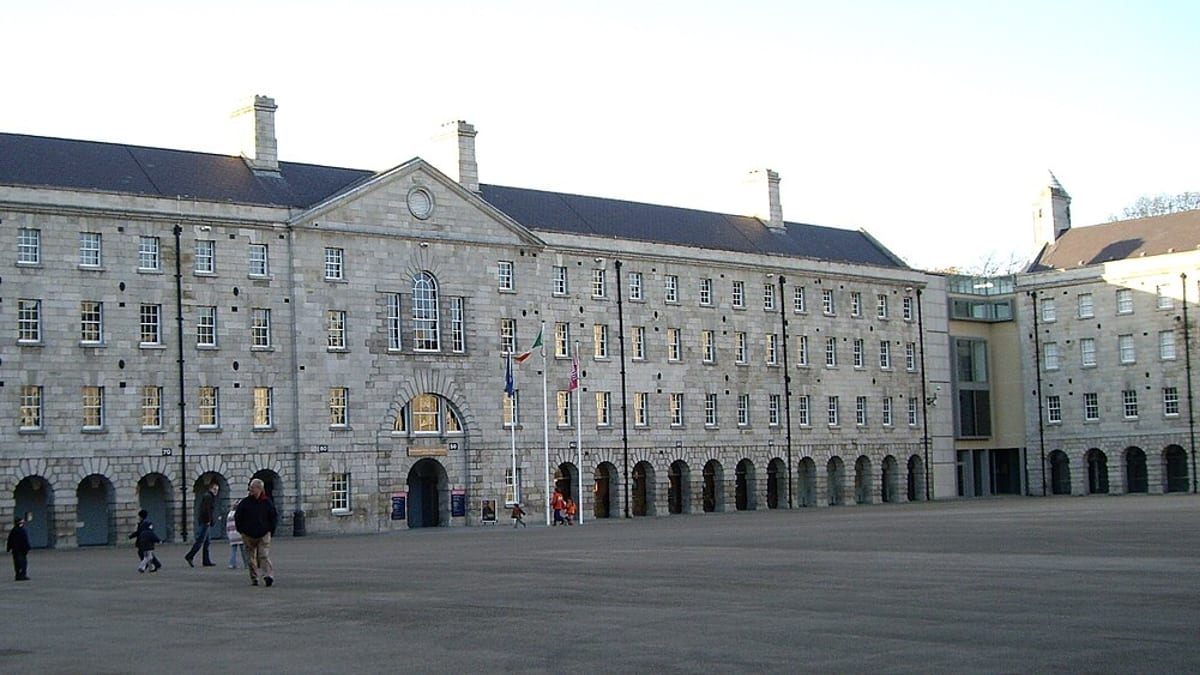
The National Museum of Ireland's Decorative Arts and History site at Collins Barracks is worth visiting for design, social history and collections that reward a closer look. General admission is free, making a focused visit easy to justify. Do not try to see everything: choose a theme, then add a contrasting gallery if time and energy permit. [1]
What kind of museum are you choosing?
This is the Collins Barracks site on Benburb Street in Dublin 7. It is not the archaeology museum on Kildare Street, the National Gallery or the closed Natural History building on Merrion Street. Those distinctions matter when following a generic recommendation to visit "the National Museum." [1][2]
The collection ranges across objects people used, wore, designed and fought with. The exhibition list includes furniture, fashion, silver, coins, craft and military history. That breadth is a strength for a mixed-interest group, but it can feel unfocused when you arrive expecting one linear account of Ireland. [3]
Choose a question to guide the visit. How did domestic objects change? What can clothing reveal about social life? How did a designer rethink ordinary furniture? Following one of those questions makes the museum more coherent than moving through rooms simply because the next doorway is open.
Allow roughly two hours as a planning starting point. A specialist could spend much longer, while a visitor with one strong interest can make a rewarding shorter visit. Free admission removes the pressure to stay until every display has been covered.
For design, start with Eileen Gray
The Eileen Gray exhibition provides a clear focus for visitors interested in modern furniture and architecture. Its objects include the adjustable chrome table and Non-Conformist Chair, alongside personal material and tools that connect the finished designs with their maker. [4]
Look beyond whether you recognise the furniture. Consider how the shape serves a body, how the materials change the object's weight or appearance, and what the design assumes about the room around it. These are useful ways to engage without needing a background in architectural history.
The personal material also helps avoid treating Gray as a name attached to an expensive chair. It introduces the process and decisions behind the work. For a short visit, this can provide more depth than racing through a broad selection of unrelated objects.
The museum warns that this exhibition can occasionally close at short notice for operational reasons. When Gray is the sole reason for your journey, contact the museum on the day. For a general visit, keep another design or decorative-arts gallery as the alternative. [4]
Choose a second theme rather than another checklist
After Gray, domestic interiors, clothing or Irish craft can extend the design thread. Alternatively, move into military history for a more distinct contrast. The permanent exhibition programme includes reconstructed rooms, The Way We Wore and Soldiers and Chiefs. [3]
Avoid assuming that a gallery title tells the entire story. A uniform can be read as clothing, evidence of an institution or part of a person's life. A piece of furniture can reveal workmanship and also the expectations of the household that used it.
This object-led approach is especially useful for visitors who do not enjoy reading every label. Choose several things that make you curious, read their context carefully and discuss them. You do not need to absorb an entire catalogue to have learned something meaningful.
Some displays have access limitations. The current exhibition notices identify Alison Lowry's installation as closed, and the Soldiers and Chiefs notice specifies a closed gallery concerning Irish service in British regiments. That is not the same as the entire museum being unavailable. [3]
The Dead Zoo Lab changes the family calculation
Collins Barracks now also houses the Dead Zoo Lab, presenting selected natural-history specimens while the Merrion Street museum is closed for conservation and refurbishment. It is not a complete relocation of the old building's experience, but it provides a genuine natural-history option at this address. [2]
This can make Collins Barracks more attractive to a family with different interests. One person may be drawn to furniture or history while another is immediately engaged by specimens. Plan a small number of shared stops rather than demanding that everyone stay enthusiastic through every room.
Use the displays as prompts for observation: compare shapes, ask why specimens were collected or discuss how museums preserve fragile material. Do not promise children a hands-on activity merely because the word "Lab" appears in the name. Check the programme separately for workshops and drop-in events.
Families do not normally need to book an ordinary visit, while groups have separate requirements. A free event may still have its own capacity or reservation rule, so distinguish general museum entry from participation in an organised activity. [2][1]
Timing matters more than the admission price
Regular hours are 10:00–17:00 Tuesday to Saturday and 13:00–17:00 on Sunday and Monday. The later opening on those two days is the practical trap for an otherwise sensible morning itinerary. Monthly late-opening events are a separate programme, not permission to assume every Thursday evening is available. [1]
If you are visiting on Sunday, use the morning elsewhere and arrive after lunch. On a weekday, the museum can work as the main morning activity before moving towards another western-city stop. Do not schedule a substantial collection visit in the final half-hour simply because the doors are still open.
The museum asks groups of eight or more to book in advance, with a minimum seven-day lead time for the self-guided booking route. A large family gathering or club outing should not rely on the rules for an individual visitor. [1]
Check the site address when arranging transport. Benburb Street and Collins Barracks are the useful identifiers; searching only the national institution's name can produce another branch.
Access, bags and making the visit comfortable
The museum provides lifts, ramps and accessible galleries, with seating and mobile stools available. These facilities make it easier to choose a route around stamina rather than treating the visit as one uninterrupted circuit. Ask reception for the most practical sequence when a particular gallery is your priority. [1]
Luggage storage is limited. Do not make the museum your unconfirmed solution for several large suitcases between checkout and an evening flight. Store travel bags elsewhere when possible and arrive ready to spend time with the collections.
Paid parking is a separate cost even though museum admission is free. For visitors already using public transport, there is no reason to add a car solely for this stop. A free museum is not necessarily a completely cost-free outing once transport and refreshments are included.
The strongest recommendation is for curious visitors willing to choose a theme. Collins Barracks is particularly worthwhile when you want substantial cultural content without another admission charge, or when the Dead Zoo Lab adds a useful family interest. Skip it only when its subject matter does not appeal - not because the collection's broad title makes it sound like a specialist attraction.
Source & editor notes
Official exhibition and visitor pages support the collection choices, access rules and partial closures. The Dead Zoo Lab is distinguished from the closed Merrion Street museum. Two hours is a planning recommendation, not a measured average visit.