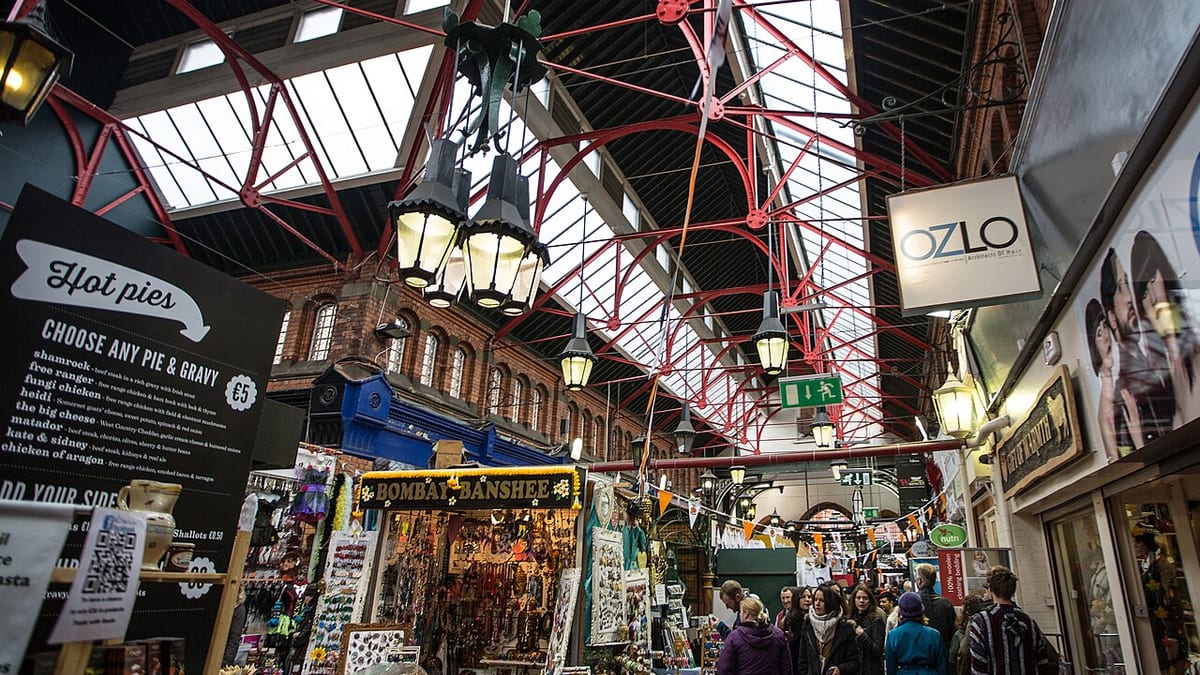
George's Street Arcade is worth a stop for independent shopping, a covered browse and a look at Dublin's market architecture. It works best as part of a southside walk, not as an attraction requiring half a day. Go with curiosity about the traders and the building, rather than expecting a large museum or an exclusively Irish-made craft market.
A historic shopping place, not a preserved stage set
The market originally opened as South City Markets in 1881. A major fire in 1892 devastated the building, which was rebuilt and reopened in 1894. That history is more interesting than the simplified claim that everything you see has survived unchanged since the first opening. [1]
The commercial purpose remains important. This is a place where individual businesses trade, not a historical reconstruction arranged solely for visitors. The mix of everyday purchases, specialist interests and gifts is part of the appeal.
Take a moment to look at the exterior before entering. Then let the interior route reveal its scale rather than rushing directly to a shop you found online. The building and the businesses work together as the experience; neither requires a lengthy guided explanation to be enjoyable.
For an architecture-only visit, a short look may be enough. A record collector, jewellery shopper or reader can easily spend longer. The right duration depends less on the size of the arcade than on whether one of its independent businesses matches your interests.
Pick a few shops rather than expecting everything
The trader directory offers useful starting points. Spindizzy serves music buyers; Stokes Books caters to readers and collectors; jewellery and design businesses sit alongside clothing, gifts and food. Treat the directory as a shortlist, then check a specific shop when its presence is the main reason for your visit. [2]
Spindizzy confirms its address at 32 Market Arcade. Its own website also lists in-store events, which can add another reason to visit when an actual date coincides with your trip. A past signing or launch is not evidence that something will be happening every afternoon. [3][4]
For records, ask about condition and pressing details before treating two copies as equivalent. For second-hand books, inspect the edition and condition rather than deciding from the cover alone. A specialist shop is most useful when you take advantage of the person behind the counter's knowledge.
Unique Crafts and Design is another distinct stop. The business describes its focus on handmade products and creative people living in Ireland. Its range is useful for someone seeking a gift with more character than a standard souvenir, but check the maker of the individual item rather than applying one origin claim to the entire shop. [5]
You do not need to buy something from every trader to make the visit worthwhile. Equally, browsing respectfully means remembering that a small shop is someone's workplace. Ask before closely photographing products, and avoid blocking a narrow entrance while your group discusses the next stop.
"Sold in Dublin" does not mean "made in Ireland"
The arcade's variety includes goods with international origins. Its directory describes Doni Doni's crafts from Mali and West Africa, for example, alongside other businesses selling Irish-themed gifts or locally designed work. That diversity is part of the market's identity, not a defect to hide. [2]
The distinction matters when buying a specifically Irish-made present. Ask who made it, where it was produced and whether the design and manufacture happened in the same place. An Irish motif on an imported item and a handmade object by an Ireland-based maker are different purchases.
Neither is automatically wrong. A visitor may prefer an international textile, a vintage garment or a record discovered in Dublin. The useful approach is to understand what you are buying rather than assume that the location of the cash register establishes provenance.
For fragile gifts, discuss packaging and transport before paying. A ceramic object that seems easy to carry around town may need more protection in a crowded cabin bag. A photograph of the maker's information and the receipt can also be useful after you return home.
Match your visit to the shop hours
The arcade's normal published hours are 09:00–18:00 Monday to Wednesday, 09:00–19:00 Thursday to Saturday and 11:00–18:00 on Sunday. Individual traders may have different hours within that period. [6]
Unique's own page, for example, lists a 10:00 opening Monday to Saturday, an hour later than the building's general weekday opening. Arriving at 09:00 because the arcade is accessible does not guarantee that your chosen craft shop is trading. [5]
Late morning or afternoon is therefore a practical choice for a general browse. On Sunday, do not build a 09:30 shopping stop into the itinerary. For a particular business, use its own current information rather than the building's closing time alone.
Holiday notices deserve extra care. The arcade's hours page still contains a St Patrick's Day entry whose weekday-and-date combination belongs to an earlier year. That is not a valid timetable for a future holiday. Use the normal weekly hours for ordinary days and obtain a current holiday notice when needed. [6]
Food is a useful addition, not the only reason to go
The directory includes coffee, snacks and casual food options. Bodega Coffee and Nutty Delights are examples of the variety, while other listed traders offer more substantial bites. Choose from what is actually open and what suits your appetite rather than assuming the arcade functions like a large communal food hall. [2]
For a group needing guaranteed seating, a full meal and a particular dietary accommodation, a separately chosen café or restaurant may be easier. Browse first, then eat nearby. That avoids turning a relaxed shopping stop into a frustrating search for enough places to sit.
Ask the food business directly about ingredients and cross-contact when allergies matter. A market-wide impression or a photograph of a menu is not a substitute for the trader's current answer.
Fit it into a compact southside route
The arcade is on South Great George's Street, with the surrounding Drury Street area providing a natural continuation. Use it between other central stops rather than travelling across the city solely to fill a long block of time. [1]
A useful plan is to approach after a morning cultural visit, browse a few shops, then continue to lunch or the neighbouring streets. In wet weather, the covered arcade offers a welcome pause, but it is not an all-weather entertainment complex for an entire afternoon.
Allow about 30–60 minutes as an editorial starting point, with extra time for specialist shopping or a confirmed event. Visitors who dislike browsing may need less. Those seeking a particular record, book or handmade gift may find the independent conversations are the most memorable part.
The fair verdict is yes as a small, characterful piece of a Dublin day. Its value comes from the combination of a working historic market and individual traders - not from trying to compete with the city's major museums or promising that every object on sale is uniquely Irish.
Source & editor notes
Trader examples are based on the arcade directory and individual business pages, not firsthand shopping. The guide distinguishes building hours from shop hours and flags outdated holiday text. Shopping provenance must be checked item by item; the market is not presented as exclusively Irish-made.